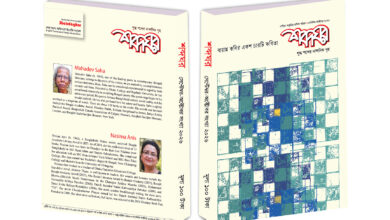


Selected English Articles of Abid Anwar
Follow-up of ‘Bangla Haiku: Phonetic Hurdles’ in the Daily Star
Ekushey Special, 21 February 2010
Introduction
It’s only in the recent years that Bangla haikus are being written with strict adherence to the metrical arrangement of three lines in 5-7-5=17 syllabic effect. Since the time of Rabindranath Tagore, the 1913 Nobel Laureate for Poetry, sporadic attempts have been made to write haikus by minor poets or by those who emerged as haiku writers only, with no track history as poets in the mainstream Bangla literature. This resulted in various individualistic forms lacking prosody-pure composition of haiku until 2005. This article analyzes the reasons behind this belated journey of Bangla haiku with correct prosody while haiku in English literature had been firmly rooted much earlier in the mainstream poetry. The article also highlights a brief Anglo-American history of the adoption process of haiku. They overcame the initial phonological hurdles long ago in 1959. Although the journey was belated, the pace of Bangla haiku is accelerated and momentum bolstered in the recent years. The article analyzes the whys and hows of this late adoption process. Some positive changes are visible by now. Those who wrote haiku without understanding its prosodic pattern have either stopped or begun to learn the art. Major poets who previously avoided haiku are now coming in large numbers to write haiku.
A. Background
Haiku is the smallest form of poetry comprising only three lines with strict metrical arrangement of 5-7-5 syllabic effect. Haiku as originated in Japan, despite its tiny structure, is capable of stirring the emotions and cognitions of readers to the extent that a full-length poem can. The basic power of attraction of a haiku lies in the image that it presents.
Before haiku could have its own identity as an independent form of poem with a discrete pattern of prosody in the works of Masaoka Shiki (1867-1902), haiku-like small pieces of verse known as ‘hokku’ had been used at the starting of long poems called ‘haika’ in Japanese language. This implies that a hokku was only a part of (or better to say a prelude to) a long piece of poem and summarized the central theme depicted in the long piece. Concepts associated with haiku as an independent entity underwent reformations in the late nineteenth century and early twentieth century.
The present author was exposed to the history of how Japanese haiku was adopted as a form of poetry in the Anglo-American arena through the French literature. A collection of the French translation of Japanese haiku was published in 1905. Five years later in 1910, these French pieces were translated into English without any attention to prosodic purity. The Imagism Movement (1910-1917) led by Ezra Pound and Amy Lowell coincided with the event, and many imagist poets showed interest in haiku because of its basic inclination toward images (if not imagery). Those who attempted to write original haiku in English included Ezra Pound, Carl Sandberg, Marian Moore, Amy Lowell, and William Carlos Williams. Although all were delighted with their exposure to a new form, nobody could write a haiku until 1959 with strict prosody as maintained in Japanese haiku. In that pursuit, an earlier piece by Ezra Pound sounded:
The petals fall in the fountain
The orange-colored rose leaves
Their ochre clings to the stone.
The piece attracted attention of many but all opined: albeit very close to haiku, it was not a real one because it ignored the rules of prosody in haiku. Ezra Pound and some others argued that every language has its own rules of prosody, and it is never possible to adhere to the Japanese metrical arrangement of 5-7-5 syllables in English compositions because phonology of the Japanese language cannot be applied in English!
Amidst those confusions, an American poet and literary scholar Richard Wright, much junior to Pound, startled the Anglo-American arena by writing the first piece of haiku with strict prosodic purity in 1959. The piece reads thus:
Coming from the woods
A bull has a lilac sprig
Dangling from a horn.
Several scholars and poets, including Ezra Pound congratulated Richard Wright for this success. Pound withdrew his initial argument that it is not possible to compose something in 5-7-5 syllabic arrangement in English. Thus, haiku found its own firm root in English poetry too. Hundreds of haikus are now being composed every day in English with the prosodic purity of 5-7-5=17 syllables.
B. Haiku in Bangla Language
Rabindranath Tagore, in his travelogue titled `Japan Jatree’ (Traveler to Japan), presented translated versions of two traditional haikus by Matsuo Basho. Scansion of Tagore’s versions of Basho’s haikus, following the English prosodic tool—equivalent to Bangla Swarobritto that assigns equal weight (value) of 1 to both open and closed syllables—gives the following counts [Bangla words are written here in Roman letters, this being an English write-up]:
Pu(1)+ra(1)+no(1)+pu(1)+kur(1)=5
Ba(1)+nger*((1)+laf(1)=3
Jo(1)+ler(1)+shob(1)+do(1)=4
Po(1)+cha(1)+dal(1)=3
Ek(1)+ta(1)+kak(1)=3
So(1)+rot(1)+kal(1)=3
Scansion of the same, following Bangla Matrabritto that assigns a weight of 2 to each closed syllable, yields the following results:
Pu(1)+ra(1)+no(1)+pu(1)+kur(2)=6
Ba(1)+nger*(2)+laf(2)=5
Jo(1)+ler(2)+shob(2)+do(1)=6
Po(1)+cha(1)+dal(2)=4
Ek(2)+ta(1)+kak(2)=5
So(1)+rot(2)+kal(2)=5
When scanned following the rules of Okkhorbritto, the only other tool of Bangla prosody, we get the following counts:
Pu(1)+ra(1)+no(1)+pu(1)+kur(2)=6
Ba(1)+nger*(2)+laf(2)=5
Jo(1)+ler(2)+shob(1)+do(1)=5
Po(1)+cha(1)+dal(2)=4
Ek(1)+ta(1)+kak(2)=4
So(1)+rot(2)+kal(2)=5
Fraction of the word `banger’ marked with asterisk* needs an explanation: the consonant ‘n’ is almost skipped in a quick pronunciation. The stress is on ‘Ba’, not ‘Bang’.
This reveals that Tagore, in his translation, paid no attention to the standard haiku structure of 5-7-5 in any of the three established principles of Bangla prosody. His whole intention was to acquaint the local readers with a unique form of poetry in Japanese language. On the contrary, Tagore set forth or refined almost all prosodic forms of Bangla poetry. Attribution of musicality to all forms of Bangla verses owes a lot to Tagore.
With the above facts, the present author conducted a survey of haikus written so far in Bangla. The survey included not only samples but all published pieces claimed to be haikus in Bangladesh and neighboring West Bengal. The survey was done through in-depth reading and analysis of their syllabic counts, putting them under rigorous judgment, using Bangla phonology as the touchstone. The process also involved a check for ‘musicality’ in those compositions to find any reasons for treating those as ‘verse’. The survey ended with frustration since all yielded a prosaic noisy sound, lacking musicality as we expect in verses. These were composed by minor poets and a small group of non-poet writers.
Exemplary scansions of haikus of the pre-2005 era deem necessary at this point to establish the proposition. Before that, we must be exposed to the basics of all established prosodic patterns in Bangla because we need a basis or foundation to cross-check the results of scansion.
Bangla prosody has three distinct patterns: Swarobritto, Matrabritto, and Okkhorbritto. The smallest unit in a line of verse is known as Matra. A group of Matras comprises line-fragments, each being called a Porbo. The said three patterns count the weight (value) of a closed syllable in varying ways. So, `syllabic effect’, instead of syllable, is more meaningful for a good reason embedded in the unique phonological characteristics of Bangla prosody. A closed syllable is given a weight of 1 in Swarobritto and 2 in Matrabritto all the time; Okkhorbritto assigns a weight of 1 for a closed syllable if it appears at the start or middle of a word but the same is counted 2 if it appears at the end of a word. The scopes for accommodation of Matras and Porbos in various prosodic rules are delineated in the following bulleted text:
• Okkhorbritto is set to accommodate only even-numbered syllables in a line of verse
• Each Porbo (line-fragment) in Swarobritto also accommodates even-numbered syllables– essentially a multiple of 4 in the main inner fragments called Purno (complete) Porbo. This rule also allows optional usage of 1, 2 or 3 syllables at the end or the beginning of a line. If a less-than-4 segmented unit is placed at the beginning, it is called Otiporbo (pre-Porbo) and if placed at the end of a line, it is termed Opurno (incomplete) Porbo. Thus, in Swarobritto, it is possible to have lines with 5 an d 7 syllables by adding respectively 1 and 3 to 4 but the combination of these forcefully-created lines with 5 and 7 syllables adjacently provides a noisy prose-like auditory (sound) effect, lacking musicality worse than a real prosaic text. This happens because a line in Swarobritto must always contain a multiple of 4, and never a single 4.
• Matrabritto allows accommodation of 4, 5, 6 or 7 `syllabic effect’ in its complete/inner Porbos, always counting 2 for each closed syllable. The sub-types are called 4-metered, 5-meterted, 6-metered and 7-meterd Matrabritto. Therefore, the combination of lines having 5 and 7 syllabic effects in a piece of verse as in a haiku is possible only in Matrabritto. The main line-fragments (complete Porbo) created through 5-metered and 7-metered Matrabritto fit well in the standard haiku structure. This combination yields an acceptable auditory (sound) effect. The proof of this musicality lies in the Tagore’s usage of this combination in long pieces of verse as discussed later in this article. So, it is evident that mere syllable counting as done in English language assigning equal weight of 1 to both open and closed syllables does not work at all in Bangla prosody. It is also clear that Matrabritto is the only tool that provides an opportunity to compose a line of poem with odd-numbered syllabic distribution as in haiku. Using the above prosodic tools as the touchstone, the present author, in his survey, found not a single piece of Bangla haiku that can claim a perfect match with the standard 5-7-5 structure.
The most discussed haiku writer in Bangla is Surendranath Moitra after Tagore as a translator. Moitra had a good degree of acceptance as a poet of the mainstream. He brought out his `Japanee Jhinuk” (Oysters of Japan) with short poems claiming these to be haikus. The most important piece rich in figurative expression and musicality due to framing in 6-metered Matrabritto reads as follows [Bangla words in Roman letters for convenience of the non-native readers; translation is done by the present author]:
Basa venge* gechhe
jak na!
E pakhir achhe pakhna
[The nest is destroyed
So what?
This bird has wings]
The syllabic scansion of this piece yielded the following results:
Ba(1)+sa(1)+ve(1)+nge*(1)+ge(1)+chey(1)=6
Jak(2)+na(1)=3
E(1)+pa(1)+khir(2)+a(1)+chhe(1)+pakh(2)+na(1)=9.
This count of 6-3-9 syllables does not conform to the standard haiku structure. The word ‘venge’ needs a special note for the foreign readers. This may seem like having an extra `e’ to include as one additional syllable but no, the unique and subtle pronunciation of this word involves a quick jump to skip the consonant ‘n’ because the stress is on `ve’, not `veng’. The poet rightly used ‘venge’ as a 2- syllabic word in his 6-metered sub-type of Matrabritto prosody.
Hasnat Abdul Hye, the most-discussed haiku writer, emerged primarily as a noted novelist and sort story writer in the 1950s. He has also authored travelogues, including one on his visit to Japan and a book titled ‘Kyoto Haiku’ in a gross prosaic language. For scanning, we need to follow a known prosodic tool as the basis, given the fact that closed syllables have varying weights in different patterns of Bangla prosody. Incidentally, we got one piece of Hasnat Abdul Hye nearly adhering to Swarobritto where he copied the first line from a famous nursery rhyme of Tagore. As Swarobritto assigns equal weight (1) to both open and closed syllable, we get the following results by scanning:
Brish(1)+ti(1)+po(1)+rhe(1)+Ta(1)+pur(1)+Tu(1)+pur(1)=8
Ma(1)+tir(1)+So(1)+da(1)+gon(2)+dho(1)+A(1)+se(1)=8
Shan(1)+ti(1)+A(1)+se(1)+ne(1)+me(1)=6.
For other examples, we chose ones with short lines that pretend to have a haiku-like structure. Although we have no basis for counting the weights of syllables in prosaic lines, let us assign an equal value (1) to each open and closed syllable as done in English and Bangla Swarobritro. The scanning of two such haikus yields the following results:
Shi(1)+shir(1)+ve(1)+ja(1)+ghas(1)=5
Sur(1)+ja(1)+lok(1)+jhik(1)+mik(1)+ko(1)+re(1)=7
Pa(1)+ta(1)+no(1)+rhe(1)+mri(1)+du(1)=6
Nil(1)+a(1)+ka(1)+sher(1)+ni(1)+che(1)=6
Ek(1)+ti(1)+sa(1)+da(1)+megh(1)+va(1)+se(1)=7
Vab(1)+na(1)+da(1)+na(1)+me(1)+le(1)=6
Hasnat Abdul Hye himself mentioned in the preface of his ‘Kyoto Haiku’ that the Japanese poets use 5-7-5 syllabic distribution in haiku but this is not possible in other languages. His statement suggests he was not aware of the structural development of haiku in another language, like English, in the 1950s.
Given this scenario, the present author identified a key point to be useful in composing Bangla haiku with standard 5-7-5 metrical structure. The 1913 Nobel Laureate Rabindranath Tagore wrote some long poems using combination of 5 and 7 syllabic effects. One of such poems is `Ganvongo’ that reads thus [Bangla words are written here in Roman letters, and Porbo (units/line-fragments) are shown with slash (/)]:
Gahichhe Kashinath/nobin juba
Dhonite sovagriho/dhaki
Konthe khelitechhe/Sathti sur
Sathti jeno pusha/pakhi….
In the following scansion of the poem, one must keep in mind: Matrabritto counts 2 in a closed syllable that may confuse the English haiku poets and scholars since they count syllables, assigning equal value (1) to both closed and open syllables:
Ga(1)+hi(1)+chhe(1)+Ka(1)+shi(1)+nath(2)=7
No(1)+bin(2)+ju(1)+ba(1)=5
Dho(1)+ni(1)+te(1)+so(1)+va(1)+gri(1)+ho(1)=7
Dha(1)+ki(1)=2
Kon(2)+the(1)+khe(1)+li(1)+te(1)+chhe(1)=7
Sath(2)+ti(1)+sur(2)=5
Sath(2)+ti(1)+je(1)+no(1)+pu(1)+sha(1)=7
pa(1)+khi(1)=2….
Note that the line-fragments (Porbo) with correct prosody in Matrabritto are used here as adjacent lines. The composition uses the 5-metered and 7-metered sub-types of Matrabritto that yields a musical auditory effect. Existence of ‘Dhaki’ and ‘Pakhi’ each having two Matras (originally placed at the end of the line) has no effect on this musicality because these tiny fragments appear after the combination of 5 and 7 is already done.
Musicality in verses of various patterns is set forth distinctly in all languages. Respective readers of verses in all languages develop the auditory senses to identify if a piece of writing is a verse or prose. This takes place in two ways: study of phonology and long-term exposure to the huge numbers of verses written by recognized poets.
C. Pioneering a Proposal
With the above background and reality, the present author wrote his first piece of Bangla haiku taking into consideration the metrical purity and musicality in Bangla Matrabritto prosody. The following analysis will clarify the structure of the piece of Bangla haiku that reads:
Biran bil
Hotash machhranga*
Vabuk chil
[Barren pool outright
Disappoints the kingfisher
Pensive is the kite]
Although English translation shows a clear count of 5-7-5 syllables, the original Bangla version in Matrabritto shows 3-5-3 if counted following the English style and Bangla Swarobritto. If, however, counting is done in Bangla Matrabritto prosodic style, this gives a perfect 5-7-5 syllabic effect, thus:
Bi(1)+ran(2)+bil(2)=5
Ho(1)+tash(2)+machh(2)+ra(1)+nga*(1)=7
Va(1)+buk(2)+chil(2)=5
This gives a clear count of 5-7-5. The word ‘ranga’ may confuse readers in the English-speaking world. The consonant `n’ in such words is almost skipped in a unique quick pronunciation. The stress is on ‘ra’, not ‘rang’. See earlier notes on similar breakage of words.
The rhyming of the first line with the last one (ABA) is maintained in translation by the present author for adherence to the original as done to satisfy the phonological choice of the readers of Bangla verses.
A Bangla article of the present author, embedding this piece as an example of prosody-pore Bangla haiku, was first published in the weekly supplement of Sangbad and immediately included in a book titled ‘Chitrokolpo O Bichitro Godya’ (Imagery and Other Prose) brought out by top-rated Agamee Prakashani in February 2005. The article provided a phonological analysis to advocate that there is no way other than Matrabritto for writing haiku adherent to 5-7-5 metrical pattern. The article also highlighted findings of the survey calling attention to the fact that earlier attempts to write haiku in Bangla yielded prosaic composition that adhered to no rules of Bangla prosody.
For brevity, only English versions of two other haikus that drew attention of the newcomers to write prosody-pure Bangla haiku are presented below:
Red silk cotton tree
Vultures seated on its branch
Flap their wings with glee
Charlands rising high
Skeleton of river peeps
Water forced to die
D. Widespread Response to the Proposal
In 2006, a young Bangladeshi poet Dulal Biswas came to the present author with his book of haiku which he dedicated to the present author as writer of that article:
The present author, by then, was exposed to the revolutionary article titled “The Season of ‘No-Season’ in Contemporary Haiku: The Modern Haiku Association Muki-Kigo Saijiki” by Richard Gilbert, Yūki Itō, Tomoko Murase, Ayaka Nishikawa and Tomoko Takaki, Faculty of Letters, Kumamoto University as published in Simply Haiku Journal 4.2 (Summer 2006). It was noted that all of Dulal Biswas’s haikus maintained the strict 5-7-5 metrical purity following Bangla Matrabritto that was advocated in the said article. It was also noted that Dulal’s haikus have an admixture of kigo and non-kigo types. Some of his non-kigo pieces seemed startling in terms of newness and depth of imagery. Here is an example: Shingel sharh/Singhasonay Bose/Folaye Gharh (Seated on the throne/A bullock inflates its neck/With horns of his own) that symbolizes a lawless dictator. Here again, the translated version shows a clear count of 5-7-5 but the original piece in Bangla sounds to have a 3-6-3 structure following English styles but when scanned following the rules of Bangla Matrabritto assigning a value of 2 for each closed syllable, this yields the 5-7-5 structure:
Shing(2)+el(1)++sharh(2)=5
Sing(2)+ha(1)+so(1)+ne(1)+bo(1)+se(1)=7
Fo(1)+laye(2)+Gharh(2)=5
For brevity, only English versions of his two more haikus:
Melody of dusk
Emits from the horizon
With colorful mask
Crop cultivators
Study the soils quite well
Knowing no letters
Dulal’s works were welcomed by the present author through a review titled “Bangla Haiku: Phonetic Hurdles” published in the Ekushey Special Issue of the Daily Star brought out on the occasion of the International Mother Language Day on 21 February 2010. The review further analyzed the phonology of Bangla prosody and strengthened the arguments for the use of Matrabritto for prosody-pure Bangla haiku first laid down in the article mentioned earlier. By then, many other prominent poets came in contact with the present author and accepted the advocacy in favor of Matrabritto prosody for writing Bangla haiku for conformation to the international structure of 5-7-5. All prosody-literate poets agreed to accept this prosodic tool for writing Bangla haiku and opined: an understanding of the reality embedded in the unique phonology of Bangla prosody may remove the confusions of global readers. One among those poets was the Director of Bangla Academy Rahima Akter Kalpana who authored a book of 300 haikus in 2021 and another with 500 haikus in 2024, all with perfect structure. In a preface to her first book, she reminisced on her exposure to the ‘pioneering article’ by the present author. Her haikus provided a further ground to say goodbye to the noisy prosaic haikus written before this intervention.
Her haikus reveal both kigo and non-kigo subject matters, both being rich in figurative expressions. One example: Rat goveerh/Jonaki jole dure/Adhare chirh (Night is dark out there/Sparkles of the fireflies/Scratch the black to tear). Sparkling fireflies are seen in the metaphor of scratches on the blackness of night to tear it. Bangla version of this haiku apparently shows a deviation from the norm of 5-7-5 structure in English style but, on ultimate calculation following Bangla Matrabritto prosody, this yields the correct 5-7-5 structure:
Rat(2)+go(1)+veerh(2)=5
Jo(1)+na(1)+ki(1)+jo(1)+le(1)+du(1)+re(1)=7
A(1)+dha(1)+re(I1)+chirh(2)=5
Examples with only English versions a few others by her, for brevity:
The cages are bare
Buffaloes with ugly teeth
Make the earth unclear
A greedy fruit-bat
Pecked onto the ripened one
Bad days this points at
Mohammad Rafiquzzaman, recipient of Independence Award (the highest state honor in Bangladesh) for lyrical poetry, commented in a preface to his first flush of haikus: “What I understand by haiku, there was nothing in our stock before Abid Anwar’s intervention. He, being the recipient of the highest state honor for lyrical poetry, has a great influence on others in the arena. Major poets who kept away from haiku because of the prosaic production by minor poets and a small group of haiku writers outside the mainstream arena of Bangla poetry are now coming in large numbers to embrace haiku. His haikus are rich in figurative expressions, not to speak of their structural perfection, for example:
Kaker dak
Ha-kora duti thote
Jhajhalo bak
[Cawing of the crow
Sharpened beaks so open wide
Take the shape of bow]
Here again, the structure of Bangla version following Matrabritto shows a perfect adherence to 5-7-5:
Ka(1)+ker(2)+dak(2)=5
Ha(1)+ko(1)+ra(1)+du(1)+ti(1)+tho(1)+te(1)=7
Jha(1)+jha(1)+lo(1)+bak(2)=5
Rafiquzzaman’s recent haikus on climate change and environmental degradation are thought-provoking since he highlights the dark side of nature that resulted from human interventions:
It’s not simply air
Sighs of the desert as loo
Cooking atmosphere
Angry is the Sun
Heated nature says it all
We must get return
Dr. Tapan Bagchi, currently the Director of Bangla Academy, author of more than hundred books on various subjects, including poetry, took to the pursuit of haiku to a visible extent, His contributions in Bangla haiku as a major poet of the time, promises to uplift the quality in terms of figurative expressions. Let us examine one:
Chiler chhana
Bosechhe vanga* dale
Urhchhe dana
[Little chick of hawk
Seated on a broken branch
Wings do fly in flock[
Scanning of the Bangla version, along with the translation, shows a perfect match with the standard haiku structure:
Chi(1)+ler(2)+chha(1)+na(1)=5
Bo(1)+se(1)+chhe(1)+va(1)+nga*(1)+da(1)+le(1)=7
Urh(2)+chhe(1)+da(1)+na(1)=5
To understand scanning of the word ‘vanga’ marked with asterisk*, see previous details of how we handle the consonant ‘n’ in such cases. Again, it’s important to say the stress is on ‘va’, not ‘vang’. Dr. Bagchi is promising in the creation of abstract imagery even using the real-world images:
Water sets the tune
Rivers turn so garrulous
Else they stop their croon
Behold a tiger
How it struts in jungles wild
Walk turns to swagger
In this technical section of the text, the present author highlighted samples of only the most renowned poets of the time to establish the propositions in this paper. One such prominent poet is Jyotirmoy Sen who is contributing visibly to haiku. We end the technical section with scanning one of Sen’s haikus that shows a clear adherence to 5-7-5 structure:
Shra(1)+bon(2)+ma(1)+se(1)=5
Pre(1)+mer(2)+bil(2)+jhi(1)+le(1)=7
Shap(2)+la(1)+ha(1)+se(1)=5
Two other examples of Jyotirmoy Sen’s haikus:
Came the spring again
All the trees got back their greens
And with no bargain
All eels live in mud
Yet they look so clean and fresh
Free from sludge and crud
E. Bangladesh Haiku Society
Bangladesh Haiku Society was founded in 2010 at the initiative of Rahima Akter Kalpana, the Director of Bangla Academy and a prominent poet and haiku writer with perfect prosody. She, being the convener, attracted a good number of members who offered me the position of Life-long President, with Rahima Akter Kalpana as the Secretary General. The intention was to bring all prosody-pure haiku writers under one umbrella, organize seminars, workshops, and training sessions on haiku and advocate the use of correct structure (5-7-5) for saying goodbye to prosaic compositions during the pre-2005 era in Bangladesh and West Bengal of India. The Society continues its activities smoothly and is enriched with a Publication Cell, namely `Vashamukh’ which, by now, published 26 books (as of 2024).
Guidelines in mother tongue for writing Bangla haiku have recently been circulated among members of the Society in the form of a booklet titled ‘Prokoronsidwa Bangla Haiku: Bilombito Ovijatra (Bangla Haiku in Correct Prosody: A Belated Journey), with the following advice in more details than mentioned below:
1. Bangla haiku must maintain the perfect prosodic purity with 5-7-5 structure
2. The 5-metered and 7-metered Matrabritto subtypes are the only guiding tools for conformation to 5=7-5 structure
3. Given the modern global trend, non-kigo haikus may be acceptable where a deep, thought-provoking imagery is used encompassing at least an event of the nature
4. Rhyming is not mandatory in Japanese and English haiku. Readers of Bangla are traditionally inclined to appreciate musicality in verses to satisfy their auditory senses. Hence, rhyming of the first line with the last one shall be maintained. English haikus, of late, are increasingly being inclined to rhyming. Therefore, let this be continued in Bangla haiku
5. For an unstressed easy flow, the composition of the first and the last line shall begin with a word with three syllabic effect, followed by any choice for the rest 2.
F. Conclusions
Evidence-based empirical analyses proved the propositional statement that Bangla haiku with perfect prosodic structure of 5-7-5 started its ‘belated journey’ since 2005 only. Compared to the structural development of haiku in English prosody, Bangla prosody did the job more than 75 years later.
The paper also provides a clear understanding that the three lines of Bangla haiku must be composed following the ‘syllabic effect’ of 5-meterd and 7-metered subtypes of Matrabritto for auditory (sound) effect needed for a verse over prosaic expressions. Citation of a long poem of Tagore as composed using these particular tools provided an extra ground for prosodic purity of Bangla haiku with its 5-7-5 structure. This intervention created a widespread consciousness among the prosody-literate poets of Bangladesh and West Bengal of India. Major poets who kept them away from haiku are coming in large numbers to write haiku as it is now firmly-rooted in the mainstream Bangla poetry.
The article had to be self-referential with no other options. Advocacy for innovations in such a self-referential style is not rare in the history of literary developments. The author presented haikus of other prominent poets and, thus, the successes achieved are seen as a product of collective efforts, not of the author alone who, for the first time, gave a solution in 2005 to cross the phonological hurdles by Bangla haiku toward achieving the standard 5-7-5 structure.
Illustration : Rajat