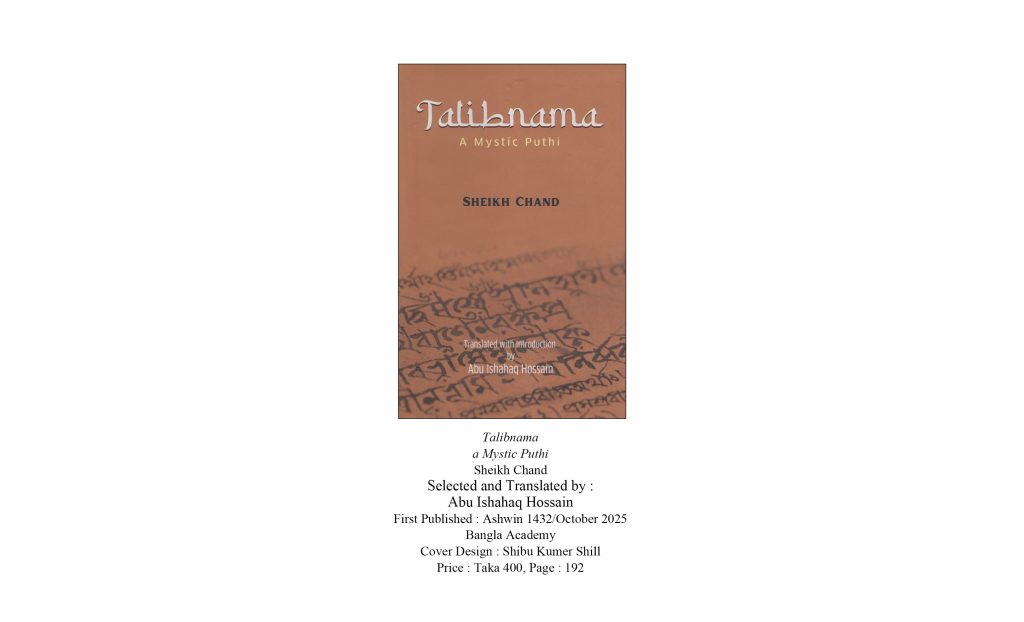
Book Review : A Publication of Bangla Academy: Talibnama- A Mystic Puthi by Sheikh Chand

Literary tradition and cultural wealth
Bangladesh is a deltaic country in Southeast Asia. Although its topographic feature does not bless its land with natural resources, it is highly blessed with its traditional cultural resources. Western scholar and researcher David G. Cashin meaningfully noted in the late 1980s, “It pains me that Bangladesh is known in the West primarily for its natural disasters and poverty. So much so that what is positive in this land is simply unknown or neglected in the West. Bangladesh can be justly proud of her long and varied literary tradition and cultural wealth. Sadly, it remains virtually unknown to the West.”!
Renowned American folklorist Donald Alan Dundes expressed a similar sentiment regarding Bengal’s rich folk tradition and folk literature. In one of his letters, he said, “Bangladesh may or may not have much in the way of exportable natural resources, but it is incredibly rich in its folklore. The songs, tales, proverbs, folk arts (including the strikingly beautiful kathas), and even epics abound…. From many points of view, Bangladesh may be one of the poorest nations on the face of the earth, but I can tell you from the folklorists’ perspective, it is clearly one of the richest.”2
History shows that throughout the ancient and medieval periods, the Bengal region was rich in traditional folk tales, fables, folk dramas, folk songs, and folk literature. Even in the eighteenth and nineteenth centuries, amid the Bengal Renaissance, Bengal had a thriving folk tradition. Herein, it can be noted that this richness in folklore, in many ways, guided contemporary scholars, thinkers, and politicians toward the path of liberty. For example, the great poet and litterateur Rabindranath Tagore was enormously submerged in folk tradition, folk literature, and folk philosophy. During the Swadeshi Movement, he infused his patriotic songs with folk elements to awaken the people’s consciousness against the ruling autocrats. Besides the songs, he also retained the folk philosophy and folk elements in his poems, dramas, short stories, novels, and essays. It is also noteworthy that Rabindranath Tagore is the pioneer in Bengali folklore studies. His passion led him to study folklore extensively and to collect various texts representing different forms of folklore, which profoundly influenced his psychosomatic construction, which later influenced his literary works.
As a member of the very enlightened Tagore family, Rabindranath at one point was given the responsibility of managing the vast family estate in East Bengal, now Bangladesh. This opened a new vista in his life, and his rather urban mindset began to seep the elixir of the oral folk tradition thriving in this part of the country. He developed an appreciation for the tenor of folk music, as well as the rich rural fables, rhymes, and philosophy. Noteworthy, it is herein, that before coming to East Bengal, he was, of course, shaping up as the harbinger of modern Bengali culture and literature. At that stage, he showed an uncanny power to bridge local music with a strong Western musical strain. However, after coming to Bengal, more precisely now Bangladesh, he discovered a new tenor in himself, which combined the essence of nature with the subtlety of the folk-religious school of music. As has been mentioned earlier, Rabindranath was the pioneer in focusing on folk literature and folk philosophy and subsequently spreading them to the elite society of the then Bengal and abroad. It is not surprising that he would, later on, see them as constituting “The Religion of Man” his very important essay written in the later phase of his life. He was highly vocal about this folk philosophy in his Hebert Lecture (1922), stating: “I felt that I had found my religion at last, the religion of man, in which the infinite became defined in humanity and came close to me so as to need my love and co-operation. This idea of mine found, at a later date, its expression in some of my poems addressed to what I called Jiban-devata, the Lord of my life. It spoke of an intense yearning of the heart for the divine which is in man and not in the temple or scriptures, in images and symbols.”
He further said, “The Religion of Man’ has been growing within my mind as a religious experience and not merely as a philosophical subject. A very large portion of my writings, from the earlier products of my immature youth to the present time, carry an almost continuous trace of the history of this growth.”
Not only this, he also carried folk literature and folk philosophy from country to country, even after becoming a Nobel laureate. Later on, in France, he also delivered an eloquent speech on ‘Indian Folk Religion, praising its inner credence and, citing one of the Baul songs by Gagan Harkara, he stated, “The first Baul song, which I chanced to hear with any attention, profoundly stirred my mind. His mind was stirred in such a way that he imitated the tune of the said song and composed a patriotic song in the era of the Swadeshi movement. Later on, after Bangladesh gained independence, this song was selected as the national anthem of Bangladesh. It is worth mentioning that Rabindranath’s way of life was also influenced to such a degree that at one stage he declared himself as one of the true representatives of the folk philosophy, which is portrayed in poem 15 of his famous poetry book ‘Patraput’,
ÔAvwg eªvZ¨, Avwg gš¿nxb
mKj gw›`‡ii evwn‡i
Avgvi c~Rv AvR mgvß nj
†`e‡jvK †_‡K
gvbe‡jv‡K,
AvKv‡k †R¨vwZg©q cyiæ‡l,
Avi g‡bi gvby‡l Avgvi AšÍi½ Avb‡›`|Õ
Translation:
I am an outcaste, I’m without Mantra
Outside all the temples
My worship is completed today
From the world of gods to the world of humans
To the luminous man in the sky
And to the man of the heart
In my innermost joy.
Dr. Mobarra Siddiqa, in the abstract of her article titled ‘Rabindra Srishti O Bangla Rupkatha,’ makes a very insightful comment on Rabindranath’s concern with folk tradition and folk literature: “Rabindranath Tagore was undeniably the most gifted Bengali writer, whose works in different branches of Bangla literature reveal an artistic excellence still unrivaled by any other. His profound love for the folk culture of Bengal finds its best expression in his writings such as ‘Lipika,’ ‘She,’ and ‘Golposhalpa.” In these works, he presents folktales, Märchen (fairy tales), terminology, themes, and characters in a highly innovative manner. Elements of folk literature are portrayed from a new dimension, and the age-old, neglected aspects of this trove of cultural gems have received a new life in these pieces.”5
On the other hand, one thing should be mentioned: even during the Bengal Renaissance, folk literature and folk philosophical maestros such as Lalon Fakir, Kubir Gosain, Lalshahi, Balahari, and their works left significant influences in awakening the rural masses. And in our every crisis, therefore, it could be said here that it is folk literature and folk philosophy that guide us.
From a historical viewpoint, we, thus, can articulate that the rural peasantry and artisan groups of this land, which we now call Bangladesh, can be termed as the real architects of imperative national values, traditions, rituals, crafts, and culture. These traditional values, social order, and culture are yet to be diminished from our rural social life.
However, the medieval Bengal mystic literary genre Puthi is a shining example of the folk culture and folk literature of Bangladesh, which essentially elevated Bengali literature to a new level.
Medieval Muslim Puthi literature, which developed between the 17th and 19th centuries as a strong literary form, contributed significantly to the development of the Bengali language. Clad with the notion of syncretism, it instilled a secular strain in Bengali language and literature. The Sufi doctrine of love and traditional Lokayata philosophy were blended, encouraging the masses to shift from dogmatism to liberal thinking. Although researcher David G. Cashin viewed Puthi writers as upholding pure Muslim faith and stated, “I disagree… [as they]… considered themselves as anything other than Muslims,” we can argue against this. Muslim rulers and writers practiced secularism in daily life. It should be noted that the Indian cognitive renaissance grew directly from the influence of Sufi saints and their ideology. Even the Bhakti movement, which surfaced in the Indian subcontinent in the eighth century, was a direct consequence of Sufism and its secular practices. Here, we use the word “secular” in a positive sense, referring to religious coexistence and reciprocity. History tells us that after arriving in India, Sufis blended their liberal ideology with local Lokayata philosophy, bringing them closer to the local people and sparking a massive change in an otherwise closed and rigid caste-ridden society.
The Bhakti Movement first evolved in Punjab in the 8th century, bringing about a sense of universality within rigid and orthodox thinking processes, eliminating dogma, and thus giving birth to a group of thinkers who aimed to liberate people from political and religious bigotry. They emphasized the love of God instead of dwelling on the rituals of worship. Ranjit Hoskote, in the introduction to his book I, Lalla: The Poems of Lal Ded, quotes Lal Ded, the saint-poetess of Kashmir from the fourteenth century, who planted the seed of liberal thought in Kashmir:
“The Bhakti movements that swept across the landmass between the fourteenth and sixteenth centuries. were popular mobilizations that opposed the hierarchical orthodoxy of Brahminism. The main emphasis of this movement was that the worship of the Divine was possible without priestly intermediaries or ritual specialists. The term Bhakti (literally meaning devotion) has been used to universalize a practice that ranged widely, from the northern Sant tradition, including Ramananda, Tulsidas, Kabir, Nanak, and Dadu, to the western Varkari lineage, with Jnanesvara, Namdev, and Tukaram as its leading figures. It also connotes several parallel developments, including the rise of the forms of Vaishnava emotionalism associated with Chaitanya in Bengal and Vallabha across northern India, as well as the consolidation of the Saivite Lingayat movement in Karnataka and Srivaishnavas in Tamil Nadu.”
If we go through the history of the Bhakti movement, we will see that its initiators and followers benevolently embraced the doctrine of love across different ideologies and religions. Indian history bears witness to instances where a Hindu preceptor accepted Muslim disciples, and similarly, a Muslim mentor had Hindu adherents. All these mentors and disciples were born Hindu or Muslim, but in their way of life, they became truly secular. It should be said that devotees have no racial or religious doctrinal identity; instead, they embrace all doctrines as paths to salvation, where no temple, mosque, or pagoda could create any hindrance or barrier.
The most sublime of the saints in the nineteenth century, Sri Ramakrishna Paramahansa Dev, profoundly stated, “Jato path, toto maat,” meaning, “As there are many doctrines, so there are many ways of salvation,” which was the ultimate teaching of the Bhakti movement.
Our most famous ancient literary specimen, Charyapada, is the first portrayal of our thinking process, though it may appear partially vague due to its linguistic obscurity and abstruseness. However, it was Muslim Puthi literature that first expressed Bengali liberal thought in a highly communicable contemporary language, incorporating vocabulary from multiple sources such as Arabic, Urdu, Sanskrit, and Farsi. Muslim Puthi poets, though Muslim by faith, were pioneers in promoting mass education for people of all classes, sects, and religions due to their liberal and secular thought’, which undoubtedly contributed to enriching the Bengali language. Even today, the medieval Muslim literary genre Puthi remains significant in mass education, capable of helping to construct a humanitarian psychic foundation.
Here, it is worth mentioning that medieval Muslim Puthi literature is undoubtedly the most important literary specimen of Bengali literature, yet it remains unheard of by the new generation. Due to its antique linguistic form, specialized vocabulary, gnostic expression, and traditional pattern, the new generation fails to explore its ethos and essence. As mentioned earlier, if we forget our folk traditions, it will push us into an existential crisis. Therefore, from both a national and personal stance, everyone should be highly concerned about the preservation of our folk traditions.
Now, in this new omnivorous era of ultra-modern technology and globalization, the question arises: how can we preserve our national resources? To answer this question, we can say that we can present Puthi literature to the new generation in modern Bengali communicative language for their better comprehension. However, it would not be wise to render it entirely into modern Bengali vocabulary because doing so would cause it to lose its elemental character, which is its spirit. On the other hand, if we render it in communicative English, it can preserve its elemental verve, allowing readers to experience the unique flavor of this literary form.
Here, it is notable that, driven by this passion, I took the initiative to render the Puthi into English with syllabic, lyrical, metrical, and prosodic transliteration so that readers could experience the original flavor of the Puthi and recite it in its traditional style and tune in English.
Medieval Muslim Puthi literature is an important part of the heritage of Bengali nationalism. However, it has never received significant patronization from researchers, and due to this, it is neglected by the West and, nowadays, in our own country as well. Yet, it can be regarded as a rich literary masterpiece. David G. Cashin confidently asserted: “There are several reasons for this neglect. First, researchers in Bengali literature in the West have almost without exception studied Calcutta-based literature. Although Calcutta is the admitted center of Bengali studies, there is clearly very little emphasis on the Muslim contribution to Bengali literature, particularly during the middle Bengali period. Manuscripts are not available, and not much attention is paid to whatever is available.”
Noted linguist Dinesh Chandra Sen, in his great book History of Bengali Language and Literature, stated in a very sorrowful tone: “As a natural consequence of this neglect, a large number of valuable manuscripts have been allowed to be eaten by worms or destroyed by fire, unknown and unheeded.” He credited the commendable efforts of the Bat-Tala press in Kolkata and added: “The Battala Printing Agencies of Calcutta, which have undertaken to minister to the literary wants of a rustic folk tradition, have preserved a considerable portion of them by printing them on paper of very inferior quality, the printer’s devil having freely distorted and tampered with the readings. Yet, though meager in number and poor in execution, the Battala Presses have preserved what otherwise would have met with certain destruction, and though late, we have now risen to a consciousness of the gratitude we owe them for this invaluable service. “9
To readdress the significance of Puthi literature and its influence on our philosophy, we think this study will open a vast horizon to the West, allowing them to recognize our nearly forgotten literary treasure, upon which our local philosophical foundation was built.
We know that Puthi is written in couplet form and has a unique style of presentation. From its inception, it has been presented in a musing style. To provide readers with the original flavor, I have translated the Puthi Talibnama (The School of Disciple), written by Sheikh Chand, while preserving its original text in rhythmic, metrical, and prosodic texture, maintaining the syllabic sequence of the original text. This ensures that foreign readers can also experience the same ethos of the Puthi and perform it in the same style and tune. In my transliteration, I followed the text as it appears in Banglar Sufi Sahitya by Ahmed Sharif, published by Bangla Academy in 1969.
Banglapedia, the National Encyclopedia of Bangladesh, confirms that there are at least 60,000 Puthis in the collections of the University of Dhaka Library, Bangla Academy, Bangladesh National Museum, Rammala Granthagar (Comilla), Maharaja Library (Dinajpur), Dinobandhu Library (Sylhet), and Varendra Research Museum (Rajshahi).10 It is truly unthinkable that so many resources have been left behind by our ancestors, yet we fail to utilize these highly enriched elements. If we can, it would be phenomenal for both our national and personal lives. We should cultivate our own assets, and it is also our responsibility to unearth these hidden treasures and present them to the world.
I believe this is high time to turn our attention to rediscovering our folk traditions and introducing them to the world so that others may realize the richness of our national heritage and philosophical credence. It must be acknowledged that in this era of globalization, maintaining our unique identity is a significant challenge. However, we can overcome this challenge by reintroducing our richest inheritance to the world, transforming globalization into a blessing for us.
I hope this study will open a new gateway for Western readers to learn about our rich traditional literary and cultural genre-medieval Muslim Puthi literature.
Notes
1. David G. Cashin; The Ocean of Love: Ali Raj’s Agma, Jnana Sagar; Bangla Academy; 1993; foreword.
2. Abu Ishahaq Hossain; Bangla Lokogan; ShovaProkash; 2017; p.12
3. Folkloric Rabindranath; anthology-2019; edited by Dr. Belal Hossen; p.185
4. Ibid; p. 323
5. Ibid, p. 514
6. David; Ibid; foreword.
7. Ranjit Hoskote (edi.) ‘I, Lalla: The Poems of Lal Ded; Penguin; New Delhi; 2011; page-xxvi.
8. David; ibid; foreword.
9. Dinesh Chandra Sen; History of Bengali Language and Literature; (1911); Calcutta University; p. 398.
10. Banglapedia: National Encyclopedia of Bangladesh; vol-11; 2nd edi; Asiatic Society of Bangladesh; 2012; p.445
Abu Ishahaq Hossain
Bangladeshi researcher, poet, writer, translator, lyricist, and television presenter.