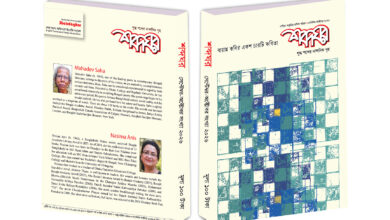


Selected English Articles of Abid Anwar
While studying journalism during the 1980s at the University of Missouri-Columbia, USA, I spent much time to understand the extent to which the writers and critics in the English-speaking world were exposed to Bangla poetry. The University, with an established Department of Bengali, has its library enriched with books on Bangla literature. To satisfy my said curiosity, I chose to read those books that were authored by critics of the English-speaking world, expressing their views on the quality of Bangla poetry.
To my surprise, I found only a few books of this category and those that were available also highlighted a distorted picture of the world of Bangla poetry, including the works of Rabindranath Thakur (Tagore) who won the Nobel Prize for his poetry in 1913. Of course, it is widely known among and agreed upon by readers of his original Bangla poetry that ‘Geetanjali’ (Song Offerings) for which he received the Award represented the ‘weaker’ works of the great poet. Yet WB Yeats, who wrote an `Introduction’ in the second edition of Tagore’s ‘Song Offerings’ published by Macmillan & Co., spoke so highly of the quality of Tagore’s works saying:
(This collection of poems by Tagore) “stirred my blood as nothing has for years….He candidly informed the readers….I have carried the manuscript of these translations about with me for days, reading it in railway trains, or on the top of omnibuses and in restaurants, and I have often had to close it lest some stranger would see how much it moved me….
Bangla poetry had a major breakthrough in the 1930s at the hands of a group of poets led by Buddhadeb Bosu who, through his Bangla translation of Charles Baudelaire’s ‘Fleurs du mal’ with an introduction, convinced the poets in this part of the world to believe Tagore’s era was ended with cessation of the Victorian era in English poetry by an overwhelming influence of the French poet Baudelaire. The movement for ‘new Bangla poetry’ gained a tremendous momentum as Tagore’s works were said to have the essence of Victorian poetry and that of the preceding Romantic era both in terms of subject matters and craftsmanship. Starting from 1914, English poetry was being flooded with Baudelaire’s revolutionary diction and his attempt to embrace the togetherness of ‘good and evil’, depicting life in its totality unlike the poets of the preceding eras, The predecessors could hardly see the ‘evil’ side of life and the nature. For exclusive dependence on love affairs and the blissful nature, Baudelaire ridiculed those poets as having created a ‘Vegetable World’. TS Eliot, albeit exposed to Baudelaire’s poems later than WB Yeats, rated his works as “the greatest exampler of modern poetry in any language.”
Under the then British colonial rule, literate Indians had English as their second language, and the poets were readily exposed to what was going on in English poetry. Poets of the post-Tagore era in this region entirely changed the diction using words and phrases that the French poets and critics called `vers libre’ and those in the English-speaking regions called ‘language of Everyday’ in sharp contrast to the Biblical Language pattern by their predecessors. In all parts of the world, the poets and critics used the same terminology—Modern—to mark the newness in their creations. Strict adherence to prosodic purity and metrical rhythm, as Baudelaire himself followed, was still being considered an essential element both in English and Bangla poetry. Most poets of the later generations tended to deviate from this norm, attributing a prose-like diction and appearance to their poems. However, this lawlessness impacted on the readership of poetry, alerting the poets for a minimum possible adherence to the acceptable forms and norms. Bangla poetry is no exception to this universal trend.
It still remains a question why English translation of Bangla poetry, is not done and made available globally at scale. Even in these days of globalization of literature through the Internet, English translations of Bangla poetry are rarely seen compared to the rate of production in Bangla language. The few that are available also portray a low quality of translation that failed to capture the essence of original Bangla versions, with rhymes and rhythms, and other aesthetic brilliance. Moreover, our major poets have little interest in translation of their works by themselves and occasionally get the job done by others who are not adept at grasping the intricacy of poesy in the original works. Some minor poets having comparatively a good command of English language are more enthusiastic in translation of their works by themselves. This process is imparting a misinformation about the quality of Bangla poetry to the readers in the English-speaking world.
For several years, concerned high-officials, alongside heads of the Bangladesh Government, in their speeches at Bangla Academy and elsewhere, have been emphasizing the English translation for global outreach of Bangla literature at scale; They also pledge necessary budget allocations for the purpose. The Modern Language Institute (MLI) of the University of Dhaka and Bangla Academy together can play their major roles in proper dissemination and portrayal of the best products of our literary pursuits by undertaking projects for translation and publication of the outputs. However, instead of taking new initiatives, the existing ones are rather being hindered for reasons unknown. A great example is the long-term discontinuation of a publication, like the Bangla Academy Journal, that had been serving as a channel for global outreach of Bangla literature, including translated poetry.
Hosting of international literary festivals at Dhaka has become almost a regular practice by now, and this has created a golden opportunity for global outreach of Bangla literature, including poetry. The success, however, depends on the heights of authors and their works that are exposed to the invited foreign participants. Unfortunately, most of our best poets cannot have access to the events because of their deficiency in English language. The projects to be undertaken by MLI and Bangla Academy should be a bit long-termed to include teaching of foreign languages with terminologies relating to poetry and other genres of creative literature. The most talented writers could be encouraged to participate in the courses and, in turn, to yield better outputs in the process of translating their own works by themselves at least into English, if not into any other foreign languages. The current practice of getting one’s poetry translated by non-poet writers has been disseminating the skeletal versions of our poetry. Exposure to these poorly-translated poems led critics in the western world to rate Bangla poetry as `banal’—a disgraceful term that undermines the brilliance of modern Bangla poetry achieved over the decades. This is happening because minor poets and writers are more enthusiastic to translate and disseminate their own works to the global audience, thus `internationalizing our `inferior products’!
Illustration : Rajat